
TL;DR
- A new metric: as AI assistants answer more questions directly, marketers increasingly talk about AI visibility, how often a brand is mentioned or cited by tools like ChatGPT, Gemini, Copilot and Perplexity.
- No single source of truth: there is no tool that reports AI mentions with full accuracy, because answers are generated per prompt, personalized and constantly changing.
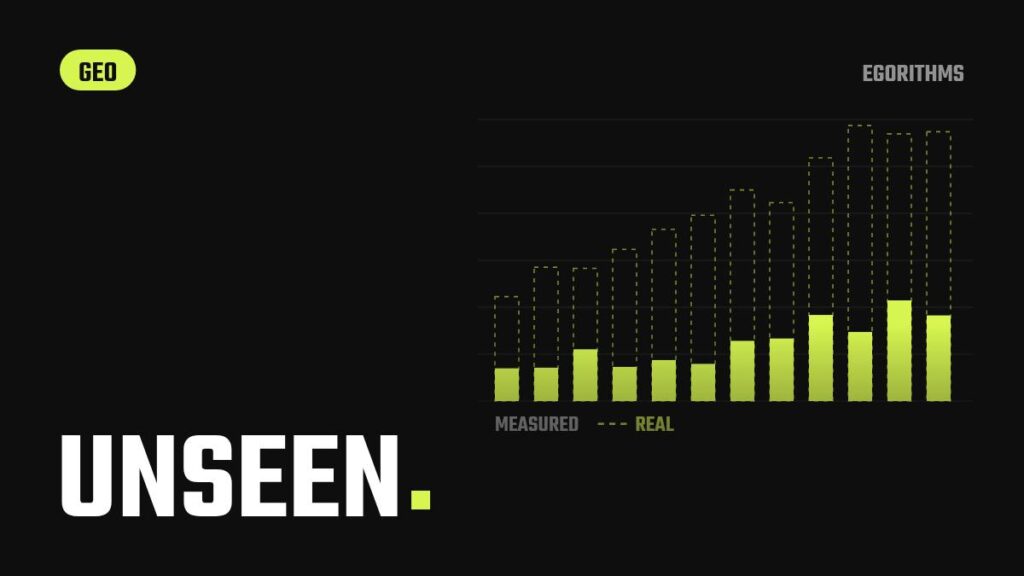
- Analytics undercount AI traffic: part of it arrives as direct traffic, part is lost to consent rules, and many answers never lead to a click.
- New official reports: Bing Webmaster Tools added AI Performance in February 2026, Microsoft Clarity made AI citations generally available in May 2026, and Google began rolling out generative AI reports in Search Console in June 2026.
- The practical approach: combine manual prompt tests, analytics filters, the platforms’ own reports and third-party tools.
Contents
- From organic traffic to AI visibility
- Why AI visibility is hard to measure
- Why analytics undercount AI traffic
- Six ways to measure AI visibility
- Official AI reports compared
- From keyword research to prompt research
- FAQ
- Vyara’s take
For two decades, success in search was measured in rankings and organic clicks. As AI assistants and AI summaries answer more questions directly, many businesses report falling organic traffic, while a growing share of discovery happens inside conversations they cannot see. The industry’s answer is a new metric: AI visibility.
From organic traffic to AI visibility
| Classic SEO | AI visibility, part of GEO | |
|---|---|---|
| Goal | Rank in the top positions for a keyword | Be mentioned, recommended or cited in an AI answer |
| Unit of research | Keyword | Prompt, a full question in natural language |
| Results | A fixed list of links | A generated answer that changes per user and prompt |
| Main metrics | Rankings, impressions, clicks | Mentions, citations, share of voice, AI referrals |
| Main tools | Search Console, Analytics, SEO platforms | A mix of manual tests, new platform reports and AI visibility tools |
GEO, short for generative engine optimization, builds on SEO rather than replacing it. For the technical side of how AI search engines choose sources, see How AI Search Decides Who to Cite.
Why AI visibility is hard to measure
- Every answer is generated. There is no stable ranking to track, only answers produced for a specific prompt at a specific moment.
- Prompts are almost never identical. Two users looking for the same thing will describe it differently, often in several sentences.
- Answers are personalized. Assistants use location, language and, increasingly, context from previous conversations.
- Models change often. A new model version can change which sources are cited.
- Local markets have less data. Third-party tools usually run fewer prompts in smaller languages, so estimates for those markets are less reliable.
Why analytics undercount AI traffic
| Reason | Effect |
|---|---|
| Missing referrer | Visits from some AI apps and copied links appear as direct traffic |
| Late tagging | ChatGPT expanded the analytics parameters on its links in June 2025, so older visits are harder to attribute |
| Consent rules | In the EU, visitors who decline analytics cookies are not fully recorded |
| Zero-click answers | Users get the answer in the AI interface and never visit the website |
| Indirect visits | A user reads a recommendation, then searches for the brand by name later |
As a result, a report showing no AI traffic for a well-known website is far more likely to be a measurement gap than a real absence of AI demand.
Six ways to measure AI visibility
| Method | What it shows | Main limitation |
|---|---|---|
| Manual prompt tests | Whether the brand appears for real customer questions | Time-consuming, must be done from neutral accounts and the right location |
| Third-party AI visibility tools | Estimated mentions and share of voice across many prompts | Sample-based, often priced per prompt, accuracy varies |
| Search Console query filters | Long, conversational queries likely linked to AI Overviews and AI Mode | Indirect signal, does not label queries as AI |
| Analytics AI channel | Sessions referred by ChatGPT, Perplexity, Gemini, Copilot and others | Undercounts for the reasons above |
| Bing Webmaster Tools AI Performance | Citations in Copilot and Bing AI answers, with grounding queries | Citations only, no clicks |
| Microsoft Clarity AI Visibility | Citations, share of authority and AI referral traffic | Covers supported AI experiences only |
Examples of third-party tools include the Semrush AI Visibility Toolkit and Ahrefs Brand Radar. They are most useful as a second opinion and for tracking trends rather than exact numbers.
Official AI reports compared
| Platform | Report | Available since | What it measures |
|---|---|---|---|
| Bing Webmaster Tools | AI Performance | Beta, February 2026 | Total citations, cited pages, grounding queries, trends |
| Microsoft Clarity | AI Visibility, Citations | Generally available, May 2026 | Page citations, share of authority, AI referral traffic, grounding queries |
| Google Search Console | Generative AI performance reports | Gradual rollout from June 2026 | Impressions in AI Overviews and AI Mode, by page, country and device |
None of these reports shows the full picture. Bing and Clarity focus on citations, while Google’s report shows impressions and, so far, no clicks.
From keyword research to prompt research
Many practitioners now complement keyword research with a prompt library, a structured list of questions customers are likely to ask AI assistants.
| Step | Practice |
|---|---|
| Platforms | Start with two or three assistants the audience actually uses |
| Prompt set | 20 to 30 realistic questions: direct, comparison, problem-based and local |
| Testing | A new chat for every prompt, a private window or neutral account, the target location |
| Recording | Date, platform, whether the brand appears, competitors mentioned, sources cited |
| Frequency | Monthly, comparing trends rather than single answers |
Search intent is also changing. A single prompt can start as an informational question and end with a product recommendation, mixing three or four intents in one answer.
FAQ
What is AI visibility?
AI visibility describes how often a brand, website or person is mentioned, recommended or cited in answers generated by AI assistants and AI search features.
Can Google Analytics show ChatGPT traffic?
Partly. Sessions with a ChatGPT referrer or tagged link can be filtered by session source, ideally through a custom channel group for AI assistants. The number should be treated as a minimum, because some visits appear as direct traffic.
Does Search Console show AI Overviews data?
Google began rolling out generative AI performance reports in June 2026, showing impressions in AI Overviews and AI Mode. The rollout is gradual, so not every site has them yet.
Are AI visibility tools accurate?
They provide estimates based on a sample of prompts run from the tool’s own infrastructure. They are useful for trends and competitor comparison, but not as exact counts.
Why test from a neutral account?
Assistants personalize answers based on the user’s history. Testing from a business owner’s own account can make the brand look more visible than it is for real customers.
How often should AI visibility be measured?
Monthly is a common starting point. Because answers vary, trends across many prompts are more meaningful than any single result.
Vyara’s take
“When a report says a well-known brand gets no traffic from ChatGPT, I don’t believe the report. There is no single button that tells you how visible you are in AI, so I combine prompt tests from neutral accounts, filters in Analytics and Search Console, and the new reports from Google and Microsoft. The biggest change isn’t the tools, though. It’s moving from keyword thinking to prompt thinking, and you can only do that if you truly understand the business.”
Further reading: How to Measure AI Visibility: The Methods I Use – Vyara Stefcheva’s practical guide on stefcheva.com.
Sources: Google Search Central on generative AI reports · Search Engine Land on Bing AI Performance · PPC Land on Microsoft Clarity Citations · PPC Land on ChatGPT link tracking
About the Author

👉Want guest posting?🪙Subscribe to the @egorithms Telegram